Design Methodology: How to gain progress towards more sustainable packaging
Making packaging more sustainable is a continuous process of setting goals, identifying challenges, seeking innovations and assessing progress. This design methodology explains that step-by-step process and organizes a procedure with which meaningful improvements to packaging may be achieved.
This design methodology is intended to align with the system of measurement outlined by the Global Protocol for Packaging Sustainability (GPPS). The GPPS should be used to understand how to measure attributes and indicators, while this design strategies should be used to gain improvements to the measurements of those attributes and indicators. The GPPS may be accessed here.
Benchmark existing designs
Before progress towards a more sustainable design can be measured, the sustainability indicators of one or more established designs should be assessed. The primary approach to assessing the sustainability of packaging is through life cycle analysis (LCA), either with the use of a simplified LCA tool or by conducting a full LCA. LCAs are used to provide a full view of impacts over an entire cradle-to-grave life cycle, which helps prevent the introduction of unintended trade-offs from one life cycle phase to another. When using LCAs to assess packaging, keep in mind that:
There’s a significant difference between simplified LCA tools and full LCAs:
Simplified LCA tools are quick, cheap, and easy to use, but are limited in flexibility and do not provide as detailed of information compared to full LCAs. Full LCAs, however, are costly and time-consuming. For benchmarking and directional guidance, simplified LCA tools often suffice, but for in-depth analyses and support of marketing claims, full LCAs are necessary.
Data is important
Data availability, quality, and consistency are often limiting factors of LCA studies. Inputs to LCA studies are usually measurements of packaging attributes such as material amounts, compositions, and conversion processes, and its important to recognize that the results of any LCA study will be no better than the quality of the input data. The estimates of sustainability indicators that are the output of LCAs are also limited by the data that relates the packaging attributes to estimates of sustainability indicators. Full LCAs use primary data that is measured specifically for the study, while simplified LCA tools rely on secondary data derived from industry averages.
The functional unit should be chosen wisely
The functional unit is the benefit or set of benefits against which impacts are assessed, and choosing the most appropriate functional unit allows a true apples-to-apples comparison to be made when evaluating the impacts of various design options. For a packaging system, the functional unit can range from a simple definition, such as containing 12oz. of product, to a complex definition that includes multiple criteria such as capacity, protection, marketability, cost, and more. Full LCAs are capable of using complex functional units, while simplified LCA tools tend to only use functional units comprising a single benefit.
You should consider the range of analysis
Because changes in one package often affect the other packages in the packaging system, an ideal assessment should include the complete packaging system. This helps prevent the introduction of unintended trade- offs from one part of the packaging system to another.
LCAs can’t measure everything
There may be certain sustainability indicators that are important to your company but cannot be measured using LCA methods. Social impacts, for example, are rarely included in LCA studies. Economic considerations also tend to fall outside of the scope of LCAs. Data may also simply not be available to estimate certain environmental impacts. Keep in mind that LCAs are extremely useful, but they don’t tell us every aspect of the sustainability of a package or packaging system.
Example
Prioritize:
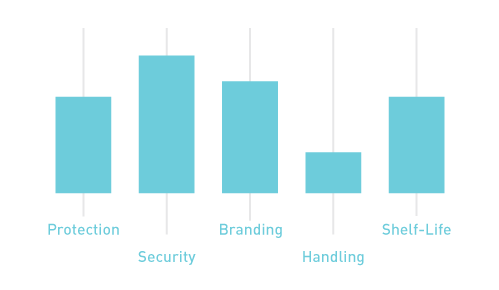
Benefits to maximize
- product protection
- tamper-evidence
- brand reinforcement
- facilitation of handling
- product shelf life
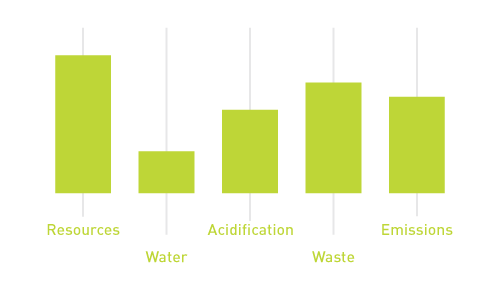
Impacts to minimize
- resource depletion
- water consumption
- acidifcation potential
- solid waste generation
- greenhouse gas emissions
Benchmark